


Seagrasses are a key resource for the National Park Service (NPS), as they provide many ecosystem services benefits. However, long-term monitoring by the NPS Northeast Coastal and Barrier Inventory & Monitoring Network has shown widespread eelgrass declines largely due to warming sea surface temperatures and eutrophication. At Cape Cod National Seashore, a 48 percent loss of eelgrass meadows over the past three decades prompted the park to develop a strategy focused on understanding threats, improving environmental conditions, and expanding eelgrass through restoration and rehabilitation.
Beginning in 2024, Dr. Alyssa Novak of Boston University (BU) and her team launched the research project Seagrass Habitat Suitability Modeling and Pilot Restoration at Cape Cod National Seashore (CACO) in collaboration with Audrey Brown and Holly Plaisted of NPS, Dr. Joel Carr from the United States Geological Survey (USGS), Dr. Rachel Schaefer of BU, and Dr. Jon Lefcheck from the University of Maryland Center for Environmental Science (UMCES). This work is part of a broader initiative using assisted gene flow to restore degraded seagrass meadows at four additional National Seashores: Fire Island, Assateague Island, Cape Hatteras, and Cape Lookout. More than 15 partner institutions, many affiliated with the North Atlantic Coast Cooperative Ecosystem Studies Unit (NAC CESU), as well as the Piedmont- South Atlantic Coast (PSAC) CESU, contribute to this regional study of eelgrass across the East Coast.
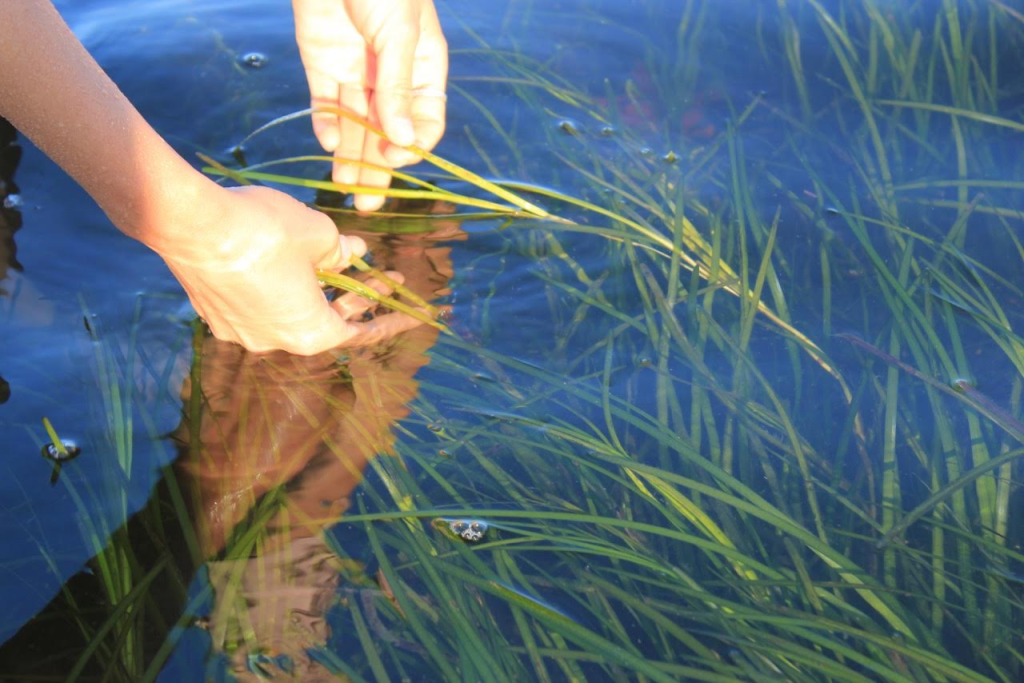
Eelgrass bed in Gloucester, MA. Photo credit: Novak Lab Boston University
The first portion of the project involves identifying sites for restoration and rehabilitation considering various scenarios for increases in sea surface temperature (SST) by 2050. Recent modeling efforts at Cape Cod National Seashore have identified 66 acres across Nauset Harbor, in Orleans, and Pleasant Bay, which borders the towns of Chatham, Orleans, Harwich, and Brewster as high-priority restoration areas. Of these, 49 are suitable for restoration without overlapping conflicting use areas, such as aquaculture and mooring areas, that can impact eelgrass. Additionally, 180 acres of depleted eelgrass meadows in Pleasant Bay have been designated as high priority for rehabilitation, with 166 acres clear of conflicting use areas. Ongoing modeling at Fire Island and Assateague Island National Seashores is still being refined, with over 80 acres at Fire Island already designated as a high priority for rehabilitation.
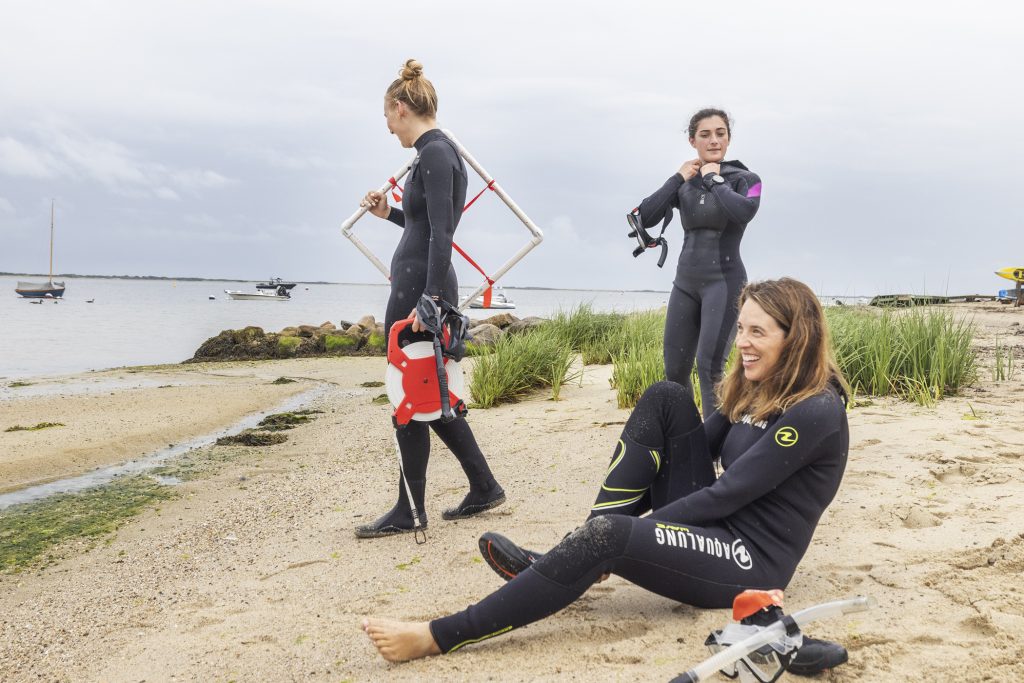
Co-project leads Dr. Alyssa Novak and Dr. Karina Scavo, and undergraduate student Kelly Fietz preparing to harvest reproductive shoots. Photo credit: Novak Lab Boston University
The second portion of the project involves performing pilot restorations using multiple donor populations to identify populations that can survive future increases in SST. This portion started in 2025 and will continue until 2027. Each year, reproductive shoots are collected from multiple donor meadows across Massachusetts, including Provincetown, Gloucester, Buzzards Bay, and Nantucket, as well as from New York’s Great South Bay and Moriches Bay, and seeds are planted into plots in CACO. The pilot restoration sites use a “common garden” experimental design, meaning eelgrass seeds from different source populations are planted side-by-side under the same local environmental conditions at each pilot restoration site. Each individual pilot site functions as its own common garden, and together the full set of pilot sites spans a range of environmental conditions across the region, providing a coordinated framework used to test restoration approaches in the field.
This approach allows scientists to directly compare how different eelgrass sources perform at a given location, helping to identify the most resilient and appropriate plant material for future large-scale restoration. By embedding common garden experiments within pilot restoration sites, the project reduces risk and strengthens the scientific basis for scaling up restoration investments, maximizing the likelihood of long-term success. These efforts run in parallel with other National Seashores down the East Coast, including Fire Island, Assateague Island, Cape Hatteras, and Cape Lookout. Efforts are led by Dr. Brad Peterson and Dr. Steve Heck of Stony Brook University (SBU), Dr. Steve Tomasetti of the University of Maryland Eastern Shore (UMES), Erin Shields of the Virginia Institute of Marine Science (VIMS), and Dr. Jessie Jarvis of the University of North Carolina Wilmington (UNCW), respectively.
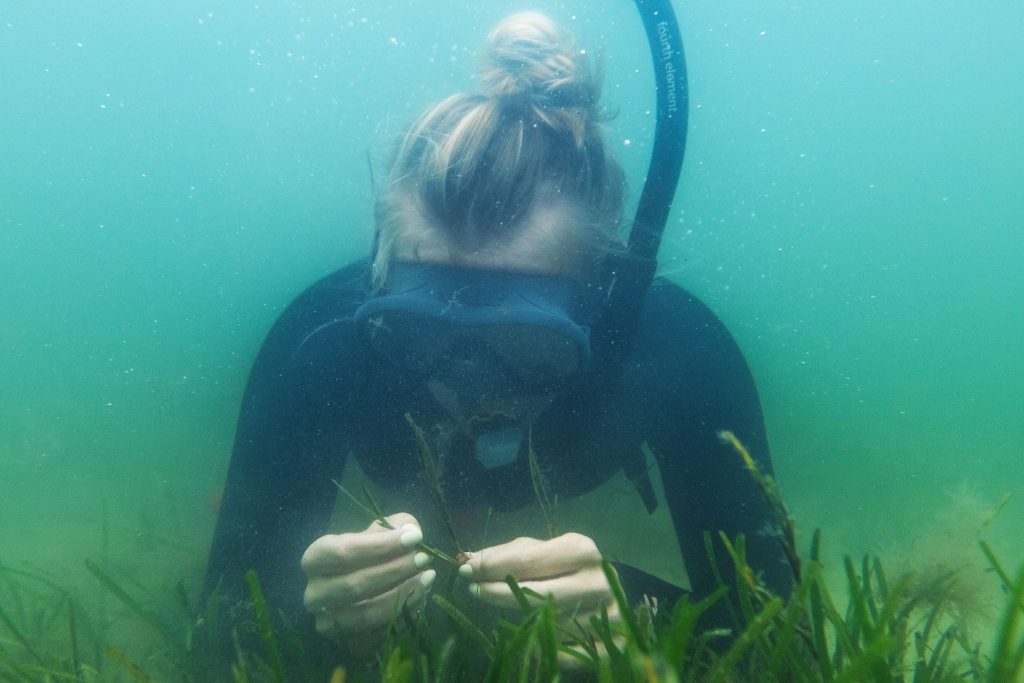
Kelly Fietz, undergraduate student, harvesting reproductive eelgrass shoots underwater. Photo credit: Novak Lab Boston University
Beyond restoring eelgrass at individual parks, this work is designed to inform natural resource managers how restoration can succeed under a changing climate. By identifying heat-tolerant populations and optimal restoration locations, the project hopes to improve long-term survival and resilience at both park and regional scales.
Continuous monitoring of the pilot sites will inform the creation of more common garden experiments along the East Coast. Researchers are also integrating environmental and genomic data to better understand how eelgrass populations vary across the region. As new data becomes available, additional habitat suitability and site selection models will be completed to guide future restoration and rehabilitation efforts. Ultimately, this collaborative research provides managers with a science-based framework for conserving existing eelgrass meadows and restoring those that have been lost. Funded by the National Park Service and National Park Foundation under task agreement P24AC02302 and research permit CACO-2024-SCI-0014, in partnership with the CESU system, these approaches aim to ensure that these important ecosystems can thrive in a warming world.